Investing in IMpact:
CoLab’s Life Course Framework for Upward Economic Mobility
CoLab invests in actionable evidence to inform public and philanthropic funding and community efforts aimed at improving upward mobility. We’ve created a life course mobility framework, built on a synthesis of more than 230 peer-reviewed studies, to guide every research investment we make. The framework also offers a common language for policymakers, philanthropic partners, and researchers who want to align around what the evidence says works.
The Problem: Eroding Mobility and an Evidence Gap
We can’t solve for stagnated economic mobility in the dark. While we certainly need greater investment into critical resources for people to thrive, spending alone isn’t the answer. The federal government spends over $1 trillion per year on a range of welfare programs. State and local governments add another $862 billion in public welfare spending. In 2024 alone, Americans donated nearly $600 billion to charitable causes. And yet, by virtually every measure, economic mobility is moving in the wrong direction.
- Intergenerational economic mobility has declined dramatically since the 1940s—falling in all 50 states and across all income levels.
- Only one in four Americans now says they have a good chance of improving their standard of living, a record low.
- 52% of Americans cannot save.
- The United States ranks among the worst OECD countries for economic inequality.
- The number of renter households spending more than 30 percent of their income on housing reached an all-time high of 22.6 million in 2023.
These trends have worsened even as high school graduation rates have risen and unemployment has remained relatively low—a critical signal that a diploma and a job are no longer enough. In 2022, 6.4 million Americans were “working poor”: they spent most of the year in the labor force and still lived in poverty. The traditional markers of self-sufficiency are no longer sufficient on their own.
The core problem is insufficient evidence about how to deploy resources for long-term impact and ways to translate reliable data to decision-making. Many programs and policies aimed at reducing poverty are never rigorously evaluated. The vast majority of evaluations that do exist follow outcomes for only one to two years—far too short to know whether programs produce lasting change, for whom they work, and whether they deliver meaningful return on investment. Without that knowledge, even well-intentioned spending cannot reliably move the needle at scale.
CoLab’s Response: Evidence with a Laser Focus
CoLab was created to close this evidence gap. We fund rigorous, longitudinal research on programs and policies with a singular goal: population-level impact on upward economic mobility.
Rather than organizing investments around topics, populations, or issue categories—as philanthropy often does—CoLab ties every dollar and every partnership to one measurable outcome. That focus orients us toward data, learning, and long-term results rather than outputs, ideology, or convenience. It keeps us accountable. And it means we actively avoid investments that lack a clear, evidence-based connection to improved economic mobility over time.
We pursue our mission through three mutually reinforcing strategies: funding longitudinal impact evaluations of promising programs and policies (studies designed to follow participants for up to 20 years); strengthening data infrastructure to enable rigorous research and policy tracking across public systems; and translating evidence into policy action at the state, local, and federal levels.
Our Framework: Following People Along the Path to Mobility
To guide investment decisions in this complex landscape, CoLab developed a life course mobility framework—built on Life Experiences that Power Economic Mobility, a synthesis of more than 230 peer-reviewed studies produced by Camber Collective, and updated by CoLab staff with research published through 2025.
The framework organizes the evidence around three core concepts:
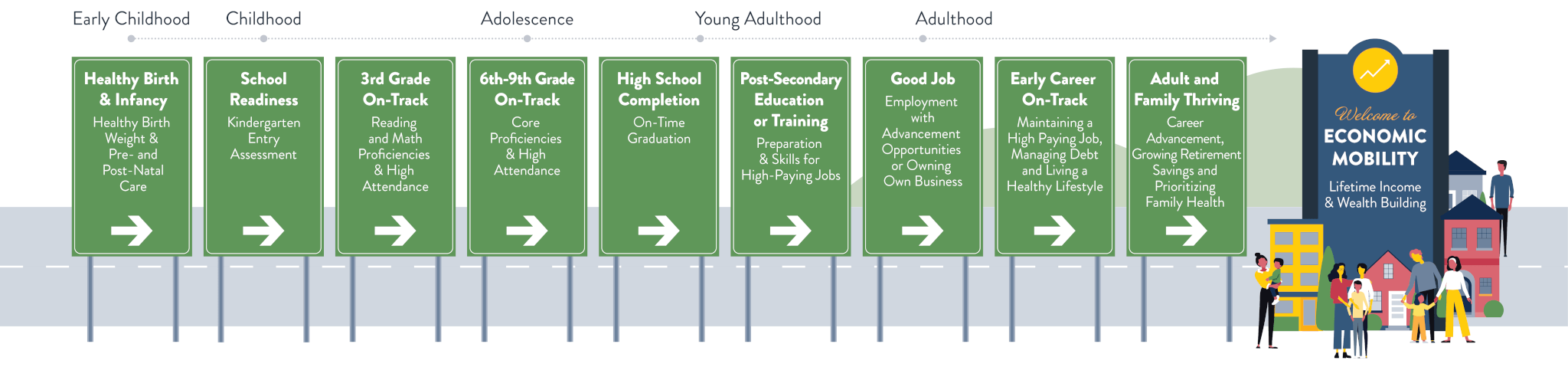
Mobility Milestones are the key developmental and economic checkpoints that research consistently links to long-term economic outcomes—from healthy birth and school readiness, through 3rd grade proficiency, high school completion, and postsecondary education or training, to landing a first good job and building lasting career stability. Reaching each milestone increases the likelihood of reaching the next one.

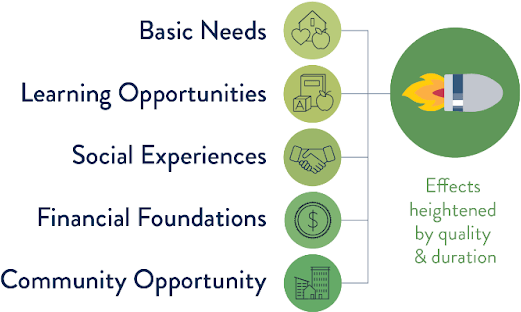
Boosters are the experiences and conditions that increase the likelihood of reaching those milestones—things like family engagement in children’s education, access to high-quality tutoring and mentoring, financial stability in the household, and growing up in a neighborhood with genuine opportunity. The evidence on booster effects is striking: completing any postsecondary credential is associated with a 39 percent increase in lifetime earnings; community-based mentorship during adolescence has been shown to raise adult earnings by 15–20 percent, with governments recouping their investment within seven years.
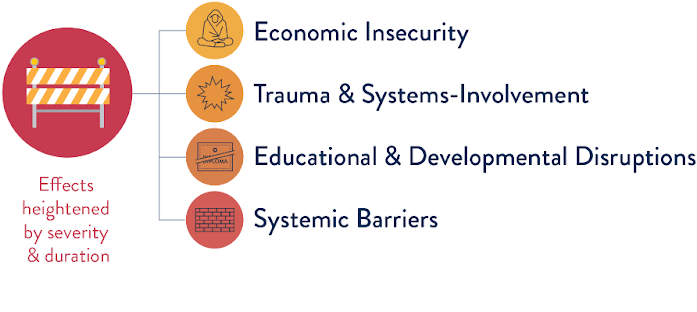
Roadblocks are the experiences and conditions that undermine progress—poverty and material hardship, exposure to trauma and violence, housing instability, contact with the juvenile or criminal justice system, and structural discrimination. These are not background noise; they are quantifiable forces that depress lifetime earnings and widen inequality.
Critically, there are no silver bullets. Children and families face multiple challenges simultaneously, and single-issue solutions rarely produce lasting change. CoLab prioritizes evaluations of multi-component interventions that tackle several boosters and roadblocks together—because the evidence tells us that compounding supports produce more durable results than isolated ones.
How CoLab Decides Where to Invest
CoLab applies a rigorous, four-level analytical framework to identify where research investments can have the greatest return:
1
Life Course Perspective — Where are children and young people falling off-track, and where are the developmental windows where timely intervention can make the greatest difference?
2
Population Impact Potential — How large an effect might an intervention produce, and how many people could realistically benefit if it were scaled? Dramatic effects for small populations and modest effects for large ones can both move the needle significantly at the population level.
3
Research Value and Feasibility — Would new research fill a meaningful gap in the evidence base, and are the conditions in place to conduct a rigorous evaluation?
4
Policy Relevance and Scalability — Is there a realistic pathway for compelling evidence to inform policy decisions and reach scale?
Once a priority area is identified, CoLab evaluates specific projects through four additional filters:

Intervention
Whether the intervention is clearly defined and replicable.

Impact Potential
Whether there is a credible evidence-based case for long-term mobility impact.

Implementation
Whether the implementing organization has the capacity, trust, and stable funding to run the program well through a multi-year study.

Evaluability
Whether the outcomes are measurable and the evaluation design is rigorous enough to establish causation.
This two-tier framework—topic priorities informed by population data and evidence synthesis, project investments screened through rigorous filters—is what distinguishes CoLab’s approach from traditional philanthropic funding. It is designed to produce not just individual studies, but a cumulative, concentrated body of evidence that can shift what policymakers and funders know and do at scale.
An Invitation to Collaborate
CoLab’s framework is not just an internal planning tool—it is a common language for cross-sector collaboration.
For policymakers:
It offers a way to connect legislative and programmatic decisions to where the evidence suggests the highest-leverage opportunities lie—and a nonpartisan, credible research partner to help answer the questions that matter most for constituents.
For philanthropic co-investors:
It provides a rigorous analytical foundation for aligning priorities, co-funding studies, and jointly translating findings into policy action.
For researchers:
It signals where CoLab sees the greatest need for high-quality longitudinal evaluation—and what we look for in research partners.
We believe that rigorous, long-term, equity-centered evidence—connected to real opportunities for policy and systems change—is one of the most powerful tools available for expanding upward economic mobility. We welcome partners who share that conviction.